
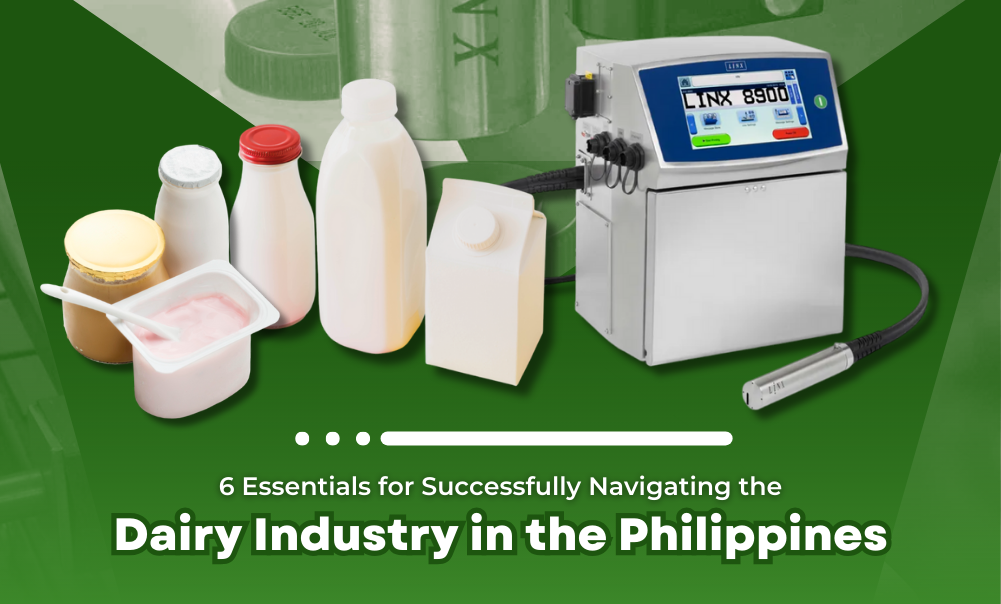
Running and maintaining a dairy business is challenging. The dairy industry in the Philippines is heavily reliant on imports rather than domestic production and manufacturing. Dairy farmers and processors are encouraged to be more competitive through better management practices and investment in sufficient, technologically advanced industrial equipment.
Fortunately, many worthwhile industrial solutions for dairy processing and packaging are available in the country. Here are some of the essential equipment and information you need to implement fruitful product innovation in your dairy business.
6 Important Equipment for Every Dairy Products Business
Dairy Packaging Materials
Maintaining excellent product integrity at all times is key to a successful dairy business. Many types of dairy product packaging nowadays don’t just protect and maintain a product’s quality, but are also tailored for the ease of use of consumers.
1. Primary Packaging
Dairy products are usually stored in bottles, cartons, cans, plastic cups, and bags. Primary packaging is most critical for the dairy industry in the Philippines because it protects the product and its quality. Dairy packaging can be made of different materials, such as aluminum, glass, plastic, and composite cartons.
Proper sterilization is necessary to keep the product from contamination and quick spoilage, especially during movement and storage within above-refrigeration temperatures.
2. Secondary Packaging
This type of product packaging is an extra layer of protection necessary for handling, storage, and transportation done by a dairy products business. Materials such as carton, paper, and plastic must be designed to combat difficulties like moisture resistance and temperature control.
For example, butter and cheese are ideally wrapped in aluminum foil and then packed in well-structured boxes. Shrink wrap can group batches of milk cartons and bottles for easy transport.
Product Coding Solutions for Dairy Goods Manufacturers
Exercising good product coding is necessary to adhere to domestic and global regulations on product packaging and food safety. Proper coding of your items also allows you to communicate vital information such as manufacturing and expiration dates, ingredients, and product batch codes. This also builds your brand’s trustworthiness in the dairy industry in the Philippines.
3. Continuous Inkjet Printer / CIJ Printer (Linx 8900 Series)
Automate the printing of batch codes, dates, barcodes, simple logos, and other kinds of text using a CIJ printer. This industrial dairy printer is highly versatile, with its capability to print information on almost any type of substrate (glass, paper, aluminum, film, metal, etc.). CIJ printers can code onto various milk cartons, aluminum cans, plastic labels, and yogurt cups.
Linx CIJ printers such as the 8900 series, bring reliable, speedy, non-contact printing to your dairy production line to ensure high-quality prints no matter the size, shape, or texture of your packaging.
4. Laser Printers (Linx Laser Coders)
Looking to cut down on manufacturing waste? You can ensure efficient printing of product information using laser printers, which reduce the need for consumables and frequent maintenance. It is another versatile industrial solution that can code on any orientation, materials, and packaging types.
Linx Laser Coders such as the CO2 and fibre laser printers deliver permanent, non-smudge print that is great for dairy products exposed to cold environments and condensation. It is easy to program and operate any Linx Laser Coder on the production floor, thanks to intuitive touch-screen controls and its low-maintenance design.
5. Thermal Transfer Overprinter (Linx TT500, TT750, TT1000)
Print onto flexible film packaging and sacheted dairy goods with an industrial-grade Thermal Transfer Overprinter (TTO). This type of printer is ideal for a dairy business that produces liquid or powder milk products packed in flexible packaging.
Linx TTO printers use a wide range of ribbons to produce consistent, high-quality label prints for your products. It also operates without compressed air and features a full-color touch screen, reducing maintenance and operational costs while providing intuitive and flexible coding.
6. Inks, Solvents, and Dairy Packaging Consumables
For dairy products that are exposed to a variety of environments during production and distribution, ink must be durable and smudge-proof. Elixir Industrial Equipment Inc., offers Linx’ industrial inks and fluids needed for Linx CIJ, TTO, and large character printers.
The following types of inks assure maximum printing quality and resistance in demanding dairy production environments:
- General purpose black inks – For printing on most common external packaging materials
- Special adherence inks – For printing on plastics, plastic films
- Contrasting inks – Pigmented, heat-tolerant ink for printing on rubbers, plastics, or metals
- Process specific inks – High resistance for challenging processes and environments like sterilization
- UV-readable inks – For discreet coding and printing applications, can only be read under UV light
- Colored inks – For printing on pale substrates or discreet coding
- Large character marking – For external case coding, brand logos, handling instructions, bar codes in large format.
Quick Facts About the Dairy Industry in the Philippines
Milk is the most important among dairy goods.
Filipino households consume mainly milk products, such as condensed milk, evaporated milk, and powdered milk. Other milk products, milk-based beverages, and desserts are also consumed by the top 30% of households. Moreover, local dairy processors and manufacturers invest in all kinds of dairy products such as:
- Liquid milk (pasteurized, skimmed, ultra-high temperature (UHT), fortified)
- Condensed and evaporated milk
- Milk powder
- Butter
- Cheese
- Cream
- Yogurt
The Philippines had the second lowest milk production in 2022 compared to other SEA countries.
The total milk production in the country was recorded at approximately 31 million liters in 2022, second only to Cambodia by a 22% difference. Meanwhile, Thailand ranked first at 1.22 million tons. This alarming difference pushed the National Dairy Authority, Department of Agriculture, dairy business owners, and many other public and private agencies to encourage innovation in the dairy industry in the Philippines.
CALABARZON is the largest regional producer of milk.
Region IV-A or CALABARZON produced around 7,800 metric tons of milk in 2023. Batangas and Laguna provinces are well-known for their high number of cattle and products. Across Visayas and Mindanao, Iloilo, Bukidnon, and Davao Occidental are also recognized as the largest milk-producing provinces.
The National Dairy Authority, public, and private agencies encourage innovation in the dairy industry.
Initiatives such as the Philippine Dairy Industry Roadmap 2020-2025 were carried out by relevant agricultural agencies to achieve short to long term goals that boost the capacity of local dairy production to meet rising demands.
Part of the roadmap’s goals is to expand the market of domestic milk products. It also promotes incorporating dairy products into school feeding programs, advocating for fresh milk, and the involvement of LGUs in the dairy production chain.
Despite the challenges faced by the dairy industry in the Philippines, domestic processors and manufacturers must be able to uphold high standards for quality assurance, product integrity, and customer trust. The key to this is ensuring superior product quality from manufacturing to distribution, as well as communicating fundamental product information.
ALSO READ: Key Factors to Consider when Choosing a Laser Coding Machine for Dairy Products
In need of reliable industrial products and services in the Philippines? Elixir Industrial Equipment Inc. is ready to serve you across our regional branches! Visit us in our Quezon City Main Office, Laguna, Mandaue City, Davao City, and Cagayan de Oro City branches for top-notch solutions to all your business needs, no matter what industry.