

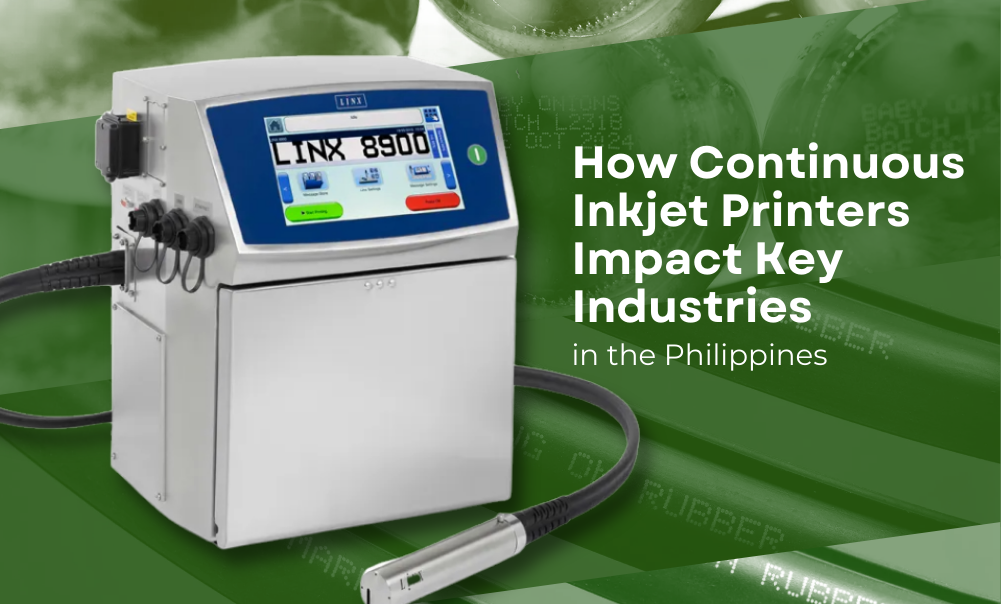
Continuous inkjet printing is highly suitable for demanding, fast-paced industries. It is used for a number of applications, such as batch coding, barcode and QR code printing, branding, labeling, and promoting product traceability. CIJ printers produce speedy, high-quality marks on various substrates. Its versatility can be seen across major industries like manufacturing, food and beverage, pharmaceuticals, logistics, and electronics. This way, key players can take advantage of efficient inkjet printing to meet evolving customer demands and keep up with industry trends.
The flexibility of continuous inkjet printers can impact businesses in many ways. Discover how CIJs can boost product throughput, ensure industry compliance, and increase a business’ competitive advantage within its sector.
The Business Impact of Continuous Inkjet Printers on Major Industries in the Philippines
Manufacturing
The manufacturing industry moves fast, and it is essential to have a printer that can handle large batches of output. Continuous inkjet printers are used mainly due to their speed and self-cleaning capability. It allows for high-volume product printing.
Manufacturers also typically use a combination of techniques to ensure product traceability. CIJ printers can print clear, vibrant graphics, such as numbers, codes, logos, and characters in either large or small format. Achieving clear product traceability is also necessary for quality control, product and customer safety.
Key Applications:
- Batch Coding – Continuous inkjet printers can produce small prints on various surfaces. Batch codes are printed for traceability and regulatory compliance.
- Barcode and QR code printing – Manufacturers affix barcodes on retail products to communicate product information and track goods. QR codes contain large volumes of information and are great space-saving solutions to sharing product details with retail customers.
- Product Traceability – The above techniques can be used to ensure that the origins and quality control of a certain product are easily accessible.
Food & Beverage
Businesses in F&B prefer the use of a CIJ inkjet printer due to its no-contact application. This advanced feature makes it a food-grade, non-toxic way to mark various materials. It can print on paper, canned, glass, plastic, and film packaging. Inkjet printing also lasts long even on packaging for frozen goods.
F&B manufacturers, retailers, and services often leverage continuous inkjet printers when declaring valuable product information (allergens, ingredients, expiry dates), and marketing their brand.
Key Applications
- Branding and Labeling – Most F&B businesses use CIJ printers to carry out their brand marketing. Food packaging or beverage containers are typically customized to reflect the business’ design, colors, and logos. It also informs the customer what the product is and its purpose.
- Product Information – Essential information such as ingredients, nutritional facts, allergens, manufacturing and expiry dates, are printed in clear, readable text. They are essential for regulatory compliance and safe food consumption.
- Sustainable Packaging – The F&B industry is adopting eco-friendly solutions, including water-based ink used to print on substrates like paper, carton, recycled, and plant-based packaging.
Pharmaceuticals
Similar to F&B, the pharmaceutical industry also makes use of continuous inkjet printing to label drugs and other medicinal products. Information such as product codes, best before, and manufacturing dates must follow the industry standard. Producers can easily program several lines of code on a CIJ inkjet printer to facilitate a seamless, uniform printing process.
One example is the Linx CIJ printer, which is widely used for marking on glass, plastic, and metal packaging. It is capable of printing up to 6 lines of characters, barcodes, and logos at high speeds. This ability increases uptime in the making of crucial pharmaceutical products.
Key Applications
- Labeling on various substrates – Different pharmaceutical packaging are made of diverse materials. Continuous inkjet printers use long-lasting inks for blister packs, bottles, cartons, sachets, and glass containers.
- Printing product information – Medical practitioners and patients need to be aware of expiry and manufacturing dates, product codes, and dosage instructions.
Logistics & Warehousing
The role of a CIJ inkjet printer in logistics mainly revolves around packaging, labeling, and inventory management. When an item is packed in its primary or secondary packaging, it is marked with product information that guides logistics personnel about its contents. A continuous inkjet printer also marks handling instructions onto boxes, cartons, and crates.
It is also a key tool for inventory management. CIJ printing is used to create RFID tags, QR, and bar codes. This way, it enhances product traceability and real-time tracking of goods.
Key Applications
- Packaging and labeling – Prints pertinent information about the contents of a certain primary, secondary, and tertiary packages.
- Supply chain tracking and traceability – Bar codes, QR codes, and RFID labels are scanned across the supply chain to log a product’s information. This is essential for ensuring product traceability and maintaining accurate inventory.
- Accurate packaging and labeling – Continuous inkjet printers allow you to pre-program data to automate labeling. This results in accurate, clear, and high-quality labels.
Electronics & Cables
Electronic devices often contain tiny, delicate components that are difficult to print on. Additionally, devices and machinery that use cables, insulation, and wires require precise printing on a curved surface. Continuous inkjet printing uses a no-contact method to eject pigmented ink onto various substrates, whether flat, curved, or angular. This is especially important for materials like PVC, metal, rubber, polyethylene, and Teflon.
Key Applications
- High-contrast printing – Color-coded cables may require inks of heavier pigments for print to be visible against various colors. The Linx CIJ printer, for example, uses contrasting inks for printing on PE cables.
- Anti-counterfeiting – CIJ printing prevents product imitations through the use of UV-readable ink. This is suitable for high-value, original products.
- Regulatory compliance – Product marking is crucial to the integrity of electronic devices. It helps ensure that an item has met certain global standards and certifications.
The versatile uses of continuous inkjet printing across multiple key sectors prove the game-changing impact of industrial markers and coders. Businesses with high volumes and a fast production phase should look into this worthwhile investment. With this, industries can enjoy various opportunities for innovation in areas like supply chain optimization, brand marketing, product traceability, and compliance.
ALSO READ: Best Practices for CIJ Printer Maintenance
Elixir Industrial Equipment, Inc. is your trusted industrial machinery supplier in the Philippines. We offer cutting-edge technology used in product packaging and labeling. Complete your production line with our top choice, the Linx Continuous Inkjet Printer. This reliable coder is designed to handle various high-speed applications and increase your business productivity. Contact us here to get a quote today.