

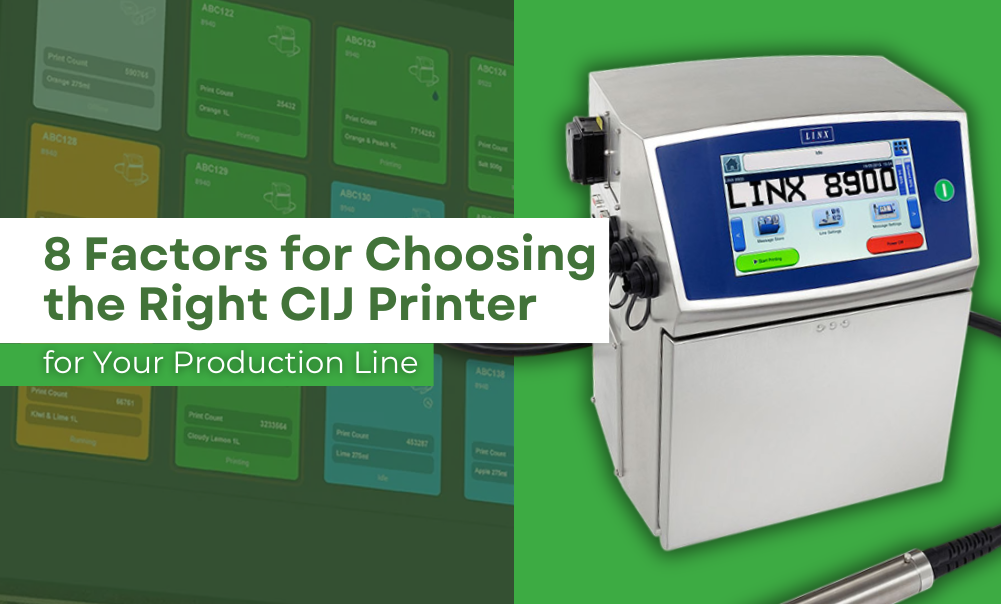
Industrial continuous inkjet printers are an indispensable part of product coding. It allows manufacturers to create high-quality markings, batch codes, expiry dates, and essential information on various substrates. Although every manufacturer needs a different set of criteria in choosing the right printer, there are some basic factors to consider other than just reliability, speed, and cost. A long-lasting CIJ printer should address your product coding requirements, and at the same time, maximize your product throughput and manufacturing capability to scale.
If you need a sturdy, versatile addition to your production line, here are the key factors you should consider when buying a CIJ printer.
8 Factors to Consider When Choosing a CIJ Printer
1. Reliability
This is perhaps the most important factor to look out for. A reliable printer doesn’t simply mean durability or a long lifespan. It must be functioning properly without failure over a designated amount of time. This means you must be aware of how long it takes before the next failure or repair.
Most industrial equipment suppliers measure reliability using standard metrics like the Mean Time Between Failures (MTBF), Mean Time to Repair (MTTR), and Overall Equipment Effectiveness (OEE). Coordinate with your chosen supplier to find out how their printers are tested.
2. Speed
If your production line demands high-volume printing, you will likely need a printer that can print on fast-moving products. Although industrial CIJ printers are perfect for the job, it is important to evaluate which model can meet your requirements while providing the best print quality for various substrates. New models support a maximum print speed up to 9.10 m/s for 6 lines of text or 2.92 m/s for 3 lines of text.
3. Ink and Color
Whether you need to print simple black text or multicolored labels, CIJ printing can handle a broad range of colors. It is also essential to ask your supplier about the specific ink types they offer. Various substrates may require special types of ink. General purpose black inks perform well on paper, plastic, metal, and glass. Pigmented ink can produce vivid marks on cables, rubber, and plastic. If you want to enhance your product security, look into UV-readable ink.
4. Operating Costs
Make sure that you have the right budget for an industrial printer. Although a high-efficiency printer may have a higher upfront price, it can result in lower operating costs. This means fewer breakdowns, increased uptime and productivity. It gives you a better return on investments rather than constantly paying for repairs.
5. Floor Space
Plan out the space to be occupied before integrating a CIJ printer into your assembly line. Depending on the complexity of your product marking process and work environment, you will need a lot of space along your line. Look for a printer that has at least IP55 or IP65 rating to ensure it can withstand harsh production environments.
6. Line and Software Integration
Consider the printer’s software compatibility and connectivity to your current infrastructure. For example, some printers offer remote connectivity via a cloud-based service. There are also flexible connectivity ports like wireless, Ethernet, or USB. This factor is crucial to ensure the entire printing process does not interfere with other stages of assembly.
7. Print Requirements
Your CIJ printing requirements will likely involve different elements. Here are common aspects to consider:
- Line Height – CIJ can typically print characters as small as 0.6mm up to large 20mm sizes. Choose a printer that can scale up or down to your coding requirements.
- Resolution – You will want clear, and legible codes to appear on your products. CIJ offers high-resolution prints for barcodes, text, and simple graphics on diverse substrates.
- Customization Options – Choose a printer that allows you to customize and create different code formats for flexible use. There are models that can also store up to 1000 messages.
8. Maintenance, Repair, and Warranty
After-sales support is as important as the initial purchase. Your supplier can instruct your and your employees on the proper use, care, and maintenance for your chosen printer. Ensure that your product is covered by a reasonable warranty length and terms. As for printheads and hardware, most CIJ parts may require replacement rather than repair. It is important to choose a responsible, trusted supplier that can coordinate all this for you.
Selecting the best CIJ printer to complete your production line becomes easier once you know what you are looking for. Beyond speed and reliability, the technicalities of your printing requirements can help you make better, informed choices on the machine you need.
ALSO READ: Continuous Inkjet Printers: A Buying Guide
Where to Buy a Long-Lasting CIJ Printer in the Philippines
Advance your production line by partnering with Elixir Industrial Equipment, Inc., the Philippines’ trusted machinery supplier. Our broad scope of products include Linx industrial continuous inkjet printers, such as the Linx 8900 series and Linx 8940 spectrum. These robust printers can produce premium text, product codes, and graphics for your unique marking needs. We also offer maintenance, repair, and training services to help you better maximize your printer.
Drop us a message today to get a quote!