
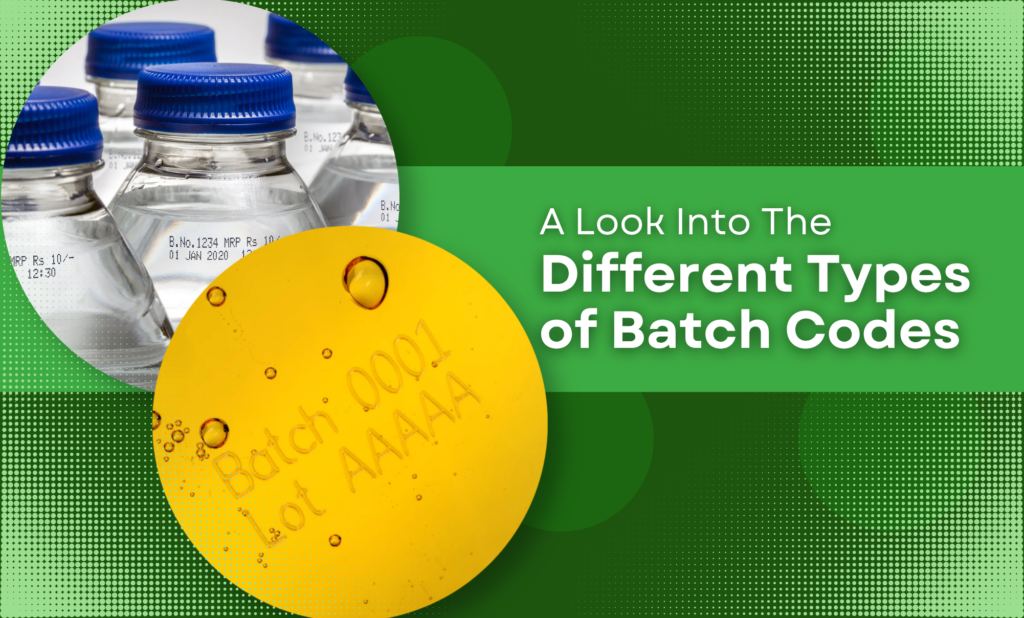
Every string of letters and numbers, bar codes, or data matrixes on your products carry significant information. Batch codes are one of the most important details on product packaging or units. These are unique identifiers that are assigned to batches of products that were made at the same time, date, location, and conditions. It is a core requirement for quality management, as mandated by ISO 9001:2015 standards. Not only does it improve product traceability, but also enhances brand image and regulatory compliance.
Familiarize yourself with the common types of batch codes, how they are presented, and the basic information that can be found across most versions.
4 Types of Batch Codes and Their Key Components
1. Alphanumeric Codes
Perhaps the most common batch code types contain a combination of letters and numbers. They are often used to represent key information such as:
- Location (Letter)
- Year (Numbers)
- Production Day (Numbers in Julian date format or other)
- Shift (Letter or Number)
For instance, the cosmetics industry commonly prints 3 or 4-character codes on the secondary packaging, such as boxes or plastic packaging. A code that reads “C79” means the product was manufactured in: C = Location/Plant C, 7 = July, 9 = 2019.
2. Date-Based
Batch codes that are printed in date formats can use the actual manufacturing date. 20261118 directly translates to November 18, 2026. However, some manufacturers use the Julian format. The format also differs for leap years and non-leap years. For example, November 18, 2026 in Julian would be 2026322.
3. 1D Barcodes
1D barcodes are traditional linear codes composed of black lines and blank spaces. Because batch codes contain a variable mix of information, the GS1-128 and ITF-14 formats are preferred when using 1D barcodes on products. These can hold data such as batch or lot information, serial numbers, expiration dates, and even net weight.
4. 2D Barcodes & Data Matrices
When 1D feels too limiting, 2D barcodes like QR codes and Data Matrix can be used to store far more detailed information about a product, as they use a variety of lines, shapes, and icons to store data. These are highly machine-readable and can be scanned using smartphone cameras, 2D imaging scanners, and more.
Information Found on Batch Codes
Distributors and manufacturers can combine specific kinds of information to form their batch codes. They can be specific to various industries, but the common data used are:
- Manufacturing Date – The day when the product was manufactured, often written using the Julian Date format (YYDD). This is necessary for product recalls.
- Production Time – Perishables like food and beverage, cosmetics, and pharmaceuticals need to print the exact production time. It is necessary for quality control, managing expiration dates, and shelf life.
- Location – The plant or factory location where the product was made. Midsize and large companies can have multiple domestic or global manufacturing sites.
- Product Code – Typically used in correspondence with a stock keeping unit (SKU), which helps manufacturers and distributors differentiate product variations, like alcohol-free products and those containing alcohol.
- Serial Number – Products that are made in multiple batches in a single day are assigned individual, unique serial numbers to distinguish one from the other, even if they were produced during the same shift or day.
- Expiration Date or Shelf Life – Perishable industries can include shelf life or expiry information in their batch codes for better quality control.
The knowledge of how to apply, code, print, and read diverse batch code types is not only vital for product identification. It directly impacts quality compliance and control, where manufacturers can manage and mitigate potential risks that flawed, defective, or contaminated products can bring.
ALSO READ: Industrial Applications of Large Character Inkjet Printers
Print Clear and Crisp Codes with a Reliable Batch Coding Machine
Elixir Industrial Equipment Inc., supplies durable, efficient, and high-yield batch coding machines in the Philippines. Invest in an industrial printer that can significantly speed up your operations in the long run. Experience minimized errors, better inventory tracking, and enhanced product traceability when you invest in a Continuous Inkjet Printer (CIJ) or Thermal Transfer Overprinter (TTO). CIJ printers deliver impeccable, quality prints across high-speed production lines, particularly on wide varieties of substrates. TTO printers, on the other hand, work best with flexible packaging and materials, preserving unmatched print clarity for extended periods of time.
Contact Elixir today to speak with one of our technical experts.